
What Is Teen Patti Master?
Teen Patti Master is associated with mobile versions of Teen Patti, a traditional Indian card game commonly played with three cards per player. Teen Patti is sometimes compared with poker because both games involve card combinations, betting decisions, and evaluating the strength of a hand.
However, Teen Patti has its own rules, card rankings, and gameplay structure. It is generally simpler to learn than many poker variations, making it accessible to people who are new to card games.
The name Teen Patti means “three cards.” In a traditional round, each participant receives three cards from a standard deck of 52 playing cards. Players then decide whether to continue in the round or fold, depending on the rules being followed.
Although different mobile versions may offer additional games and features, understanding traditional Teen Patti provides a useful foundation.
How to Play Teen Patti Master: Step-by-Step Guide
Before exploring advanced decisions, beginners should understand how a standard Teen Patti round works.
Step 1: Understand the Game Setup
Traditional Teen Patti uses a standard deck of 52 cards without jokers. Usually, three or more players participate, although the exact number of supported players can depend on the game or platform.
Every participant receives three cards, which are kept hidden from other players.
Step 2: Start with the Boot Amount
In traditional Teen Patti, the boot is the initial contribution made by participating players before the cards are dealt. These contributions form the starting pot.
For example, if four players each contribute 10 virtual chips, the starting pot contains 40 virtual chips.
The boot amount and chip rules may differ between game tables.
Step 3: Receive Three Cards
After the initial contributions, each player receives three cards face down. The cards remain private until a showdown or another rule requires them to be revealed.
Players can choose to remain blind or look at their cards and play seen, depending on the available rules.
Step 4: Choose Your Action
During a typical round, players may have several choices:
- Blind: Continue without looking at your cards.
- Seen: Look at your cards before making decisions.
- Chaal: Continue the round by placing the required contribution.
- Pack: Fold your cards and leave the current round.
- Show: Compare cards when the applicable showdown conditions are satisfied.
The required contributions and permitted actions can vary according to whether a player is blind or seen.
Step 5: Compare the Cards
When the game reaches a showdown, the remaining players compare their three-card combinations. The hand with the higher ranking wins under the applicable rules.
Understanding card rankings is therefore one of the most important parts of learning Teen Patti.
Teen Patti Master Card Rankings: Highest to Lowest
Teen Patti has six main hand categories. Each category represents a different type of three-card combination.
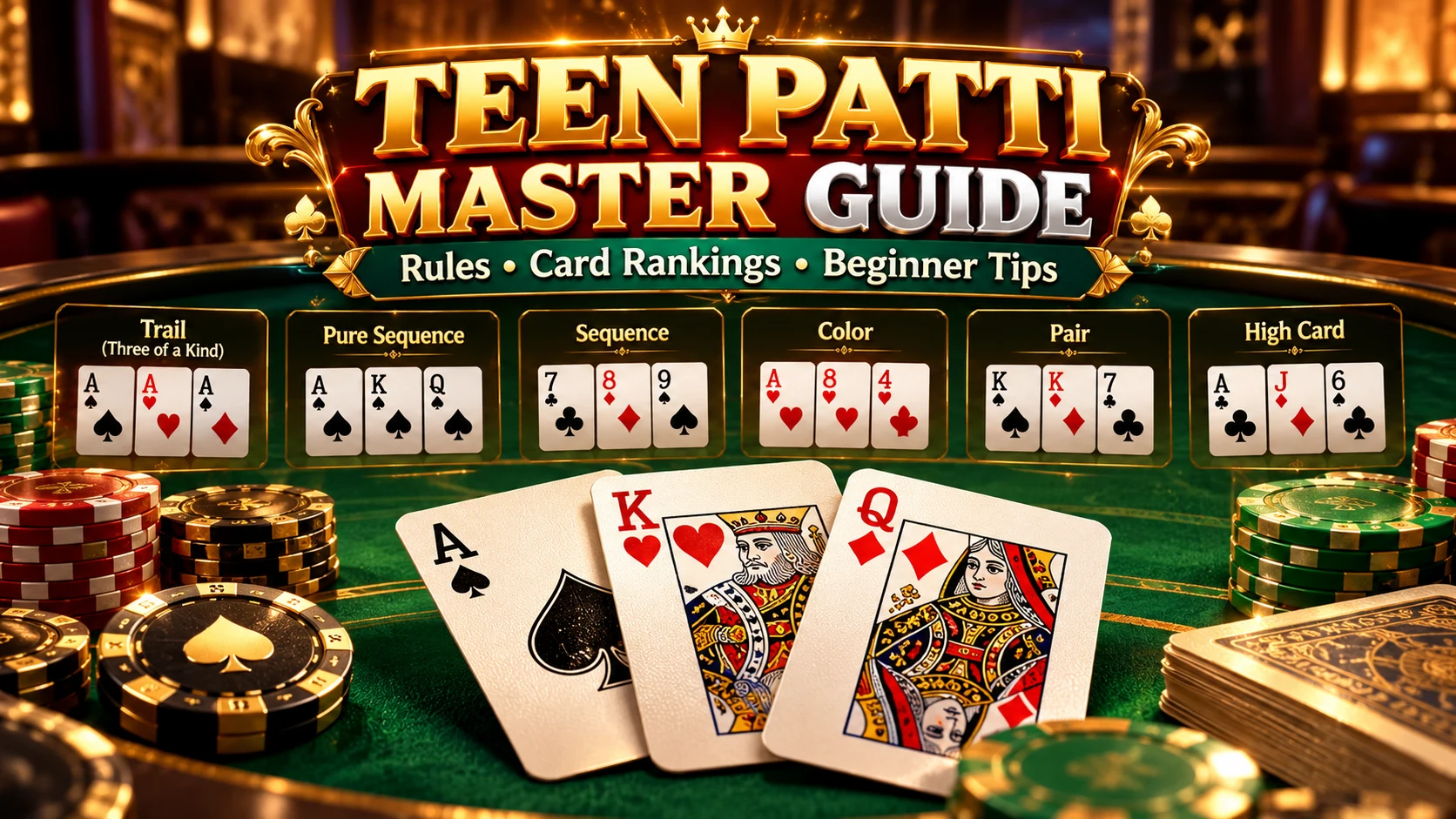
The standard ranking order is Trail, Pure Sequence, Sequence, Color, Pair, and High Card.
1. Trail or Trio – Three Cards of the Same Rank
A Trail, also known as a Trio or Three of a Kind, is the strongest traditional Teen Patti hand category.
It contains three cards of the same rank.
Example: A♠ A♥ A♦
Three aces form the highest Trail, followed by three kings, three queens, and so on. Three twos form the lowest Trail.
Because only four cards of each rank exist in a standard deck, a Trail is relatively uncommon.
2. Pure Sequence – Three Consecutive Cards of the Same Suit
A Pure Sequence consists of three consecutive cards belonging to the same suit.
Example: A♠ K♠ Q♠
Another example is 5♥ 6♥ 7♥.
A Pure Sequence is stronger than an ordinary Sequence, even if the ordinary Sequence contains high-value cards.
In many traditional Teen Patti rules, A-K-Q is the highest sequence and A-2-3 is the next highest. Some variations use different sequence ordering, so players should check the rules of their particular game.
3. Sequence or Run – Three Consecutive Cards
A Sequence contains three consecutive card ranks, but the cards do not all belong to the same suit.
Example: 7♣ 8♦ 9♠
The important requirement is that the card ranks form a valid consecutive combination.
A Sequence ranks below a Pure Sequence but above a Color.
4. Color or Flush – Three Cards of the Same Suit
A Color consists of three cards from the same suit that do not form a consecutive sequence.
Example: A♥ 8♥ 4♥
All three cards are hearts, but their ranks are not consecutive.
When two players have a Color, the highest cards are compared first. If those are equal, the second-highest cards are compared, followed by the third.
5. Pair – Two Cards of the Same Rank
A Pair contains two cards of equal rank and one card of a different rank.
Example: K♠ K♦ 7♣
When comparing two Pair hands, the higher pair wins. If both players have the same pair rank, the remaining card, commonly called the kicker, determines the stronger hand.
For example, K-K-A beats K-K-9 because the ace is a stronger kicker.
6. High Card – No Other Ranking Combination
A High Card hand contains three cards that do not form any of the combinations described above.
Example: A♣ J♦ 6♠
When comparing High Card hands, the highest card is considered first. If the highest cards match, the second-highest cards are compared, followed by the third.
High Card is the lowest traditional Teen Patti hand category.
Teen Patti Card Ranking Chart
The following table summarizes the six standard Teen Patti hand categories.
| Rank | Hand | Example | Description |
|---|---|---|---|
| 1 | Trail | A♠ A♥ A♦ | Three cards of the same rank |
| 2 | Pure Sequence | A♠ K♠ Q♠ | Consecutive cards of one suit |
| 3 | Sequence | 7♣ 8♦ 9♠ | Consecutive cards of mixed suits |
| 4 | Color | A♥ 8♥ 4♥ | Three cards of one suit |
| 5 | Pair | K♠ K♦ 7♣ | Two cards of the same rank |
| 6 | High Card | A♣ J♦ 6♠ | No matching hand category |
Blind vs Seen in Teen Patti Master
Blind and Seen are two important terms in Teen Patti. Understanding the difference helps beginners follow the game more easily.
What Is Blind Play?
A blind player continues participating without looking at their three cards.
Because the player does not know their hand, blind play involves additional uncertainty. Traditional rules often allow different contribution amounts for blind and seen players.
Blind play does not automatically improve the quality of the cards or increase the probability of receiving a strong combination.
What Is Seen Play?
A seen player has looked at their cards and can make decisions based on the combination they hold.
Knowing the cards makes it possible to identify whether the hand contains a Pair, Sequence, Color, or another combination.
However, seeing a strong hand does not guarantee winning because another player may have an even stronger combination.
Difference Between Blind and Seen
| Feature | Blind | Seen |
|---|---|---|
| Cards Viewed | No | Yes |
| Hand Knowledge | Unknown | Known |
| Contribution Rules | Blind limits apply | Seen limits apply |
| Decision Information | Limited | Includes own cards |
For beginners, learning the basic hand rankings through practice rounds is generally more useful than relying on blind play.
Important Teen Patti Master Terms Beginners Should Know
Teen Patti uses several terms that may be unfamiliar to new players.
Boot
The initial contribution made by each player before a round begins.
Pot
The total chips or stakes contributed during a round.
Chaal
An action used to continue participating in a round by making the required contribution.
Pack
Folding a hand and withdrawing from the current round.
Show
The process of revealing and comparing cards when showdown conditions are met.
Side Show
In certain traditional variants, a seen player may request a private comparison with the immediately preceding eligible seen player. The exact eligibility, acceptance, and folding rules depend on the variant.
Dealer
The person or game system responsible for distributing cards.
Hand
The three cards assigned to a player during a round.
Teen Patti Master Tips for Beginners
Learning Teen Patti is not only about memorizing card combinations. It also involves understanding the rules, recognizing uncertainty, and developing responsible playing habits.
1. Learn the Card Rankings First
Before starting a round, become familiar with all six hand categories. Many beginner mistakes happen because players confuse a Sequence with a Pure Sequence or assume that a high card beats a Pair.
Reviewing the ranking chart regularly can help you identify combinations more quickly.
2. Start with Practice Games
If a game offers free practice or non-monetary play, use that option to learn the interface and rules without financial pressure.
Practice sessions are especially useful for understanding how turns, folds, and showdowns work.
3. Understand Each Game Mode
Not every Teen Patti variation follows identical rules. Some versions may include jokers, modified rankings, different showdown conditions, or additional gameplay features.
Read the instructions for the selected mode instead of assuming that all tables operate the same way.
4. Do Not Confuse Luck with Skill
The cards received in Teen Patti are determined by the shuffle and deal. Learning the rules improves understanding, but it does not allow players to control future cards.
A strong hand may still lose to a stronger hand, and no playing method guarantees a winning outcome.
5. Practice Comparing Similar Hands
Try comparing hands within the same category. For example, learn how two Pair hands are evaluated or how the highest card determines the stronger Color when the suits match.
This makes it easier to understand results during a showdown.
6. Set Clear Time and Spending Limits
Card games can be engaging, so it is important to establish boundaries before playing.
Where monetary play is involved and legally permitted, only adults should participate, and no one should use money needed for essential expenses. Avoid chasing losses or treating a card game as a source of income.
7. Take Breaks Between Sessions
Long playing sessions can make it harder to concentrate. Taking regular breaks helps maintain a balanced experience.
8. Check the Rules Before Joining
Some tables have special rules for card comparison, contributions, or the final showdown.
Understanding these conditions before participating helps prevent confusion.
Common Teen Patti Master Mistakes to Avoid
Beginners often make mistakes because they misunderstand how card combinations work.
Confusing a Color with a Pure Sequence
Three cards of the same suit do not automatically form a Pure Sequence. The ranks must also be consecutive.
For example, 4♠ 5♠ 6♠ is a Pure Sequence, while 4♠ 8♠ J♠ is a Color.
Assuming a Pair Beats a Sequence
A Pair is weaker than a Sequence under standard Teen Patti rankings.
Ignoring the Third Card in a Pair
If two players have pairs of the same rank, the remaining card can determine the stronger hand.
Assuming Every Version Has Identical Rules
Different applications and table variations may use modified gameplay settings. Always check the instructions for the mode being played.
Believing Previous Results Predict Future Cards
Previous rounds do not establish which cards will appear in the next independently shuffled round. A run of particular outcomes does not guarantee that a different result is due.
Teen Patti Master Rules: Example Round
Consider a simple practice round involving three players: Player A, Player B, and Player C.
Each player receives three cards:
- Player A: K♠ K♥ 5♦ — Pair
- Player B: 7♣ 8♦ 9♠ — Sequence
- Player C: A♥ 8♥ 4♥ — Color
At showdown, Player B has the strongest hand because a Sequence ranks above a Color and a Pair.
Player C has the second-strongest hand, while Player A has the weakest of the three combinations.
This example demonstrates why understanding hand categories matters more than simply looking at the highest individual card.
Is Teen Patti Master Easy for Beginners?
The basic rules of Teen Patti are relatively straightforward. Most new players can learn the six hand categories and understand the general flow of a round through a few practice sessions.
However, learning the rules is different from predicting outcomes. Teen Patti includes chance, incomplete information, and variation between game formats.
Beginners should focus on understanding the game rather than expecting consistent results.
How Is Teen Patti Different from Poker?
Teen Patti and poker share certain characteristics, but they are not identical games.
| Feature | Teen Patti | Texas Hold’em Poker |
|---|---|---|
| Starting Cards | Three private cards | Two private cards |
| Community Cards | None in standard play | Five shared cards |
| Hand Evaluation | Three-card rankings | Best five-card hand |
| Blind Play | Common gameplay option | Different meaning |
| Traditional Origin | Indian subcontinent | United States |
Teen Patti is generally easier to understand at a basic level because it uses only three cards and a shorter list of hand categories.
Teen Patti Master Guide: Frequently Asked Questions
What is the highest card combination in Teen Patti?
Trail is the highest standard Teen Patti hand category. Three aces form the strongest Trail.
Which is stronger, a Pure Sequence or a Sequence?
A Pure Sequence is stronger because all three consecutive cards belong to the same suit.
Is a Color stronger than a Pair?
Yes. Under traditional Teen Patti rules, a Color ranks above a Pair.
What does blind mean in Teen Patti Master?
Blind means continuing the round without looking at your three cards.
What does pack mean in Teen Patti?
Pack means folding your hand and leaving the current round.
Can beginners learn Teen Patti without spending money?
Yes. Beginners can study the rules, compare sample card combinations, and use free practice modes when available.
Does a high card always win in Teen Patti?
No. High Card is the lowest hand category. Even a low-ranking Pair beats a High Card hand under standard rules.
Are Teen Patti Master rules the same in every version?
Not necessarily. Some versions may offer special game modes, additional features, or different table rules.
Can Teen Patti results be predicted?
No reliable method can predict cards from a properly randomized shuffle. Previous results do not guarantee future outcomes.
What should beginners learn first?
Beginners should start with the six card rankings, basic game terminology, blind and seen play, and the rules for comparing hands.
Final Thoughts
Learning Teen Patti Master begins with understanding the traditional rules and the six standard card rankings. Once you can recognize a Trail, Pure Sequence, Sequence, Color, Pair, and High Card, it becomes much easier to follow how each round works.
Beginners should take time to understand blind and seen play, practice comparing hands, and review the rules of individual game modes. Remember that receiving cards involves chance, and no strategy can guarantee a particular result.
Use this Teen Patti Master guide as a reference whenever you need to review the basics, learn an unfamiliar term, or compare card combinations.